How to solve it
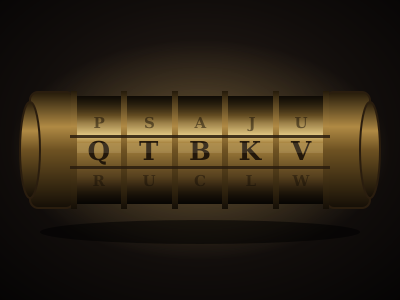
A cryptex is a cylinder of engraved rings held between two end caps. Turn every ring so the row under the line spells the secret word, then pull the end caps. The riddle engraved on the plaque is the clue, and usually the only one.
- Turn a ring by dragging it up or down. A hard flick keeps it spinning for a few glyphs before it settles on a detent. The mouse wheel turns it one glyph at a time.
- Use the keyboard if you know the answer. Up and Down turn the focused ring, Left and Right move between rings, and typing a letter jumps the ring to it and moves on to the next one. You can type the whole word in one go.
- Pull the end caps with the tab under the plaque, or press Enter.
If the word is wrong, the cylinder jolts and the caps refuse to budge. That costs one attempt, and the rings stay where you left them. By default a wrong pull tells you nothing about which rings were right, so think before you pull. When the word is right, the caps slide off and light spills out of the seams.
Setting it up
Pick Cryptex as the type, then set the mechanism.
- Rings sets the length of the word, from 3 to 8. Difficulty sets this for you: 4 rings on Easy, 5 on Medium, 6 on Hard and 7 on Deadly. It is the only thing difficulty changes on a cryptex.
- Glyphs are letters by default. You can also use digits, Elder Futhark runes or your own set of 2 to 36 symbols.
- Solution word appears when you write the solution yourself. Leave the puzzle on a generated solution and Bookwyrm picks a dungeon word of the right length (SWORD, CRYPT, BASILISK and so on), so players who own the puzzle can't look the answer up.
- Riddle is always shown to the players. Up to 500 characters. With a generated word, keep the riddle general or write the word yourself.
- Rings that are right glow faintly after a wrong try turns the cryptex into a guessing game the party will win eventually. It is off by default for good reason.
The rings always start scrambled, never already spelling the answer. From the board's right-click menu you can also Set the solution by playing: turn the rings to your word and save it.
When the party is stuck, Rule out a wrong option locks one ring onto its correct glyph for everyone. It never locks the last free ring, so somebody still has to pull the caps.
Where it fits in a campaign
- The archivist's dead drop. A murdered sage left a cryptex in her study. The riddle on its plaque quotes a line she underlined in a book the party found two sessions ago.
- A dwarven runecask. Swap the glyphs for runes and the word for a clan name carved over the hall's door. Players who paid attention to the architecture solve it in seconds.
- Vault keys in a heist. The noble keeps the safe-room key inside a cryptex on his desk. The password is his late wife's name, which the bard can find out over dinner.
Running any puzzle
Every puzzle type is built and run the same way. The guide above covers what's particular to this one.
Write it once
A puzzle is a compendium entry. Create a new Puzzle in one of your compendiums and choose its type. The form has four tabs. Overview holds the type, a spoiler-free flavour line, an optional cover image and the settings below.
- Who operates it is one player driving while the party watches, everyone operating it, or you operating it while players watch. You can always operate it yourself, whatever you pick.
- Difficulty is Easy, Medium, Hard or Deadly. Changing it rewrites the settings that tier controls and leaves your solution and text alone, so pick a tier first and fine-tune afterwards.
- Solution is either written by you or generated each time the puzzle is placed. Generated is the default, so players who own the puzzle can't look up the answer. Reroll the solution each session gives a recurring puzzle a fresh answer every session.
- Limits set a maximum number of attempts, a time limit (with the option to show players the timer) and a lockout. With a lockout, running out of attempts locks the puzzle for a while. Without one, the puzzle fails.
The other three tabs are Mechanism, which holds the settings described above, Hints, where you write up to ten hints to reveal from the board when you choose, and Presentation, for the skin, the title, an intro and the text players see on success or failure.
Put it on the board
At the table, open the Puzzles tab in the dock and drag a puzzle onto the map, or click it to drop it in the middle of your view. That makes a copy for this table only. Its progress lives with the table, and the compendium entry stays untouched. Most puzzles sit on the map as an object. Pressure plates and rune sequences can also lay tiles on the scene for tokens to step on.
There's no separate step to start it. The first player to touch it starts it. In single-driver mode, that player takes the controls and everyone else watches every move live.
Run it live
Right-click a placed puzzle for the DM's controls. The most useful ones:
- Reveal a hint and Rule out a wrong option for a party that's stuck.
- Open it by magic (Knock) or Force it open when a spell or a crowbar should simply win.
- Give one more attempt, Pause the timer and Reset.
- Approve the solve or Reject the solve, with an optional reply, if you asked to approve solves first.
- Set up… to change this table's copy and choose what happens When it is solved and When it fails. Outcomes can open or unlock a door, reveal a token, object, handout or another puzzle, play an effect, post to chat, roll damage or start combat.
Skip the minigame
Not every table wants to play every puzzle. Set a placement's Just roll option to Always and the puzzle shows a single Roll to resolve button instead. Players roll the puzzle's Just roll skill against its DC, which defaults to Investigation at DC 15. A pass solves it and a fail costs an attempt. Set it to Never to make the party play it out.