How to solve it
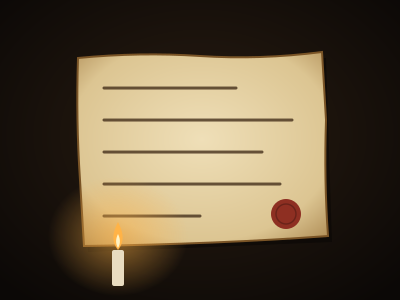
You get a letter that reads like an ordinary letter, or a blank page. Something about it is off. The real message is written in the gaps between its lines, and you can't see a word of it until the page is unlocked.
Unlocking the page
Your DM decides what reveals the writing: candle heat, a UV lens, detect magic, comprehend languages, a skill check or simply their say-so. If a check is allowed, a Search the page button rolls it. A failed search costs an attempt. Otherwise, tell the DM what you're doing to the page and they unlock it for you.
Raising the message
- Sweep the light by holding the pointer down and dragging across the page. Hovering moves the light without lighting it.
- On the keyboard, the arrow keys move the light (Shift moves it further), Space lights it or puts it out, and Enter reads.
Each hidden word blooms in as the light touches it. The colour gives the method away: brown script under a candle, cyan under the lens, pale violet for detect magic, gold for comprehend languages. A meter shows how much of the message is legible and how much you need. Once you're over the line, press Read the message. Below it, the writing is too faint. Sweeping costs nothing, so take your time.
Setting it up
- Visible letter is the cover text everyone can read, up to 600 characters. Leave it empty for a blank page.
- Hidden message is the secret, up to 400 characters, with no word over 32 characters. Both texts have to fit on one page.
- Revealed by lists the methods that unlock the page. The default is candle heat, a skill check and the DM's say-so.
- Revealing check is the skill and DC for the Search the page button. Investigation is the default, and the DC follows the difficulty: 10, 13, 16 or 19.
Difficulty also sets how hard the page is to read.
- Light radius shrinks from 110 on Easy to 50 on Deadly, on a page 1000 wide.
- Legible at rises from 60% of the message to 90%.
- Writing stays lit once found is on for every tier except Deadly, where words fade again once the light moves on.
With a generated solution, the hidden lines are scattered across the free lines with random indents. With your own, they're written from the top. Rule out a wrong option unlocks the page with your first chosen method, and each use after that brings out one more word.
Where it fits in a campaign
- The innocent letter home. A guard captain's letter to his mother, full of weather and gossip. Under a candle, the gaps spell out the hour the gate will be left open.
- A spy's ledger page. Lock it to comprehend languages. The party has to find a wizard who knows the spell, or go and buy the scroll.
- The blank map. Leave the visible letter empty. A map the party paid good gold for turns out to be blank until someone casts detect magic over it.
Running any puzzle
Every puzzle type is built and run the same way. The guide above covers what's particular to this one.
Write it once
A puzzle is a compendium entry. Create a new Puzzle in one of your compendiums and choose its type. The form has four tabs. Overview holds the type, a spoiler-free flavour line, an optional cover image and the settings below.
- Who operates it is one player driving while the party watches, everyone operating it, or you operating it while players watch. You can always operate it yourself, whatever you pick.
- Difficulty is Easy, Medium, Hard or Deadly. Changing it rewrites the settings that tier controls and leaves your solution and text alone, so pick a tier first and fine-tune afterwards.
- Solution is either written by you or generated each time the puzzle is placed. Generated is the default, so players who own the puzzle can't look up the answer. Reroll the solution each session gives a recurring puzzle a fresh answer every session.
- Limits set a maximum number of attempts, a time limit (with the option to show players the timer) and a lockout. With a lockout, running out of attempts locks the puzzle for a while. Without one, the puzzle fails.
The other three tabs are Mechanism, which holds the settings described above, Hints, where you write up to ten hints to reveal from the board when you choose, and Presentation, for the skin, the title, an intro and the text players see on success or failure.
Put it on the board
At the table, open the Puzzles tab in the dock and drag a puzzle onto the map, or click it to drop it in the middle of your view. That makes a copy for this table only. Its progress lives with the table, and the compendium entry stays untouched. Most puzzles sit on the map as an object. Pressure plates and rune sequences can also lay tiles on the scene for tokens to step on.
There's no separate step to start it. The first player to touch it starts it. In single-driver mode, that player takes the controls and everyone else watches every move live.
Run it live
Right-click a placed puzzle for the DM's controls. The most useful ones:
- Reveal a hint and Rule out a wrong option for a party that's stuck.
- Open it by magic (Knock) or Force it open when a spell or a crowbar should simply win.
- Give one more attempt, Pause the timer and Reset.
- Approve the solve or Reject the solve, with an optional reply, if you asked to approve solves first.
- Set up… to change this table's copy and choose what happens When it is solved and When it fails. Outcomes can open or unlock a door, reveal a token, object, handout or another puzzle, play an effect, post to chat, roll damage or start combat.
Skip the minigame
Not every table wants to play every puzzle. Set a placement's Just roll option to Always and the puzzle shows a single Roll to resolve button instead. Players roll the puzzle's Just roll skill against its DC, which defaults to Investigation at DC 15. A pass solves it and a fail costs an attempt. Set it to Never to make the party play it out.